Oversized Units
Normally, units occupy only one location while in the realm.
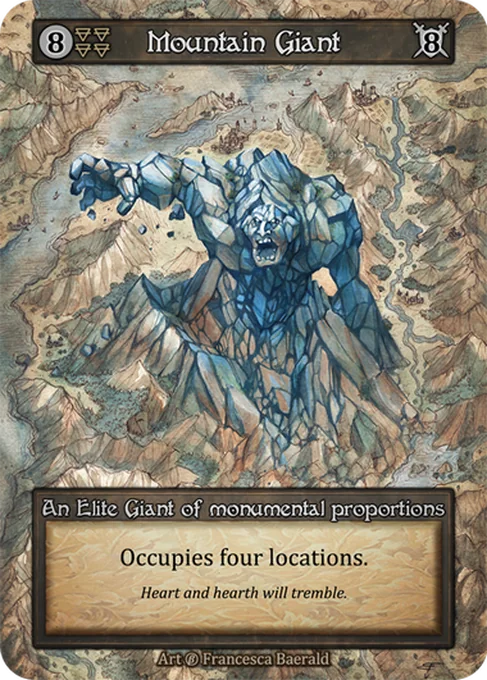
However, some oversized units occupy multiple locations simultaneously due to their size, e.g. Mountain Giant. To represent the minion's locations, place the card at the intersection of the sites. Casting an Oversized Unit When you cast such a minion, declare the area it will occupy when summoned, which must include at least one of your sites, per normal minion casting rules.
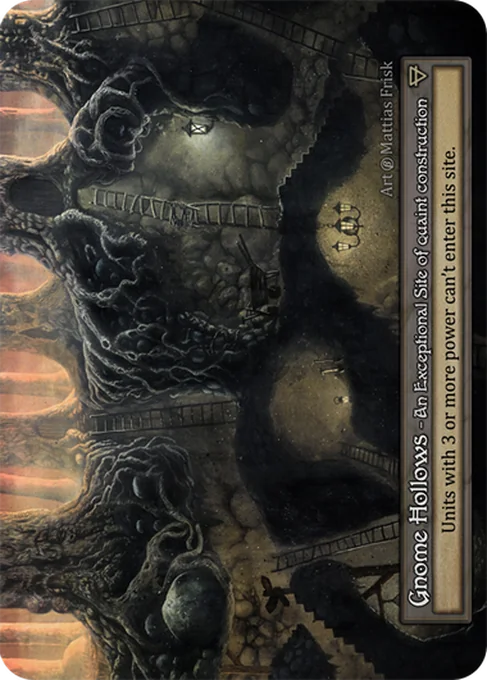
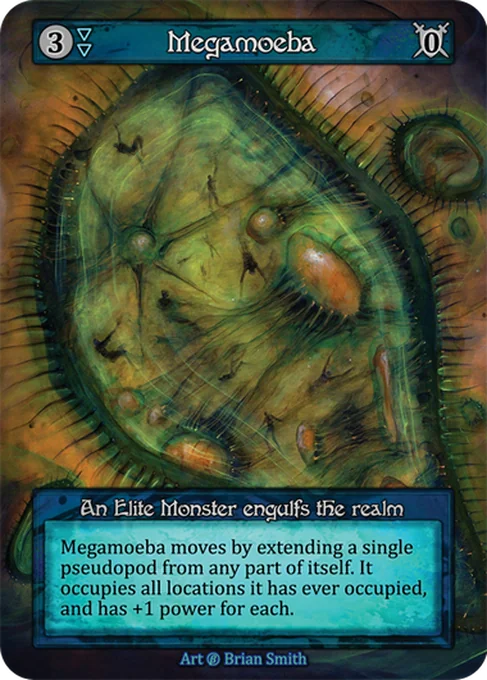
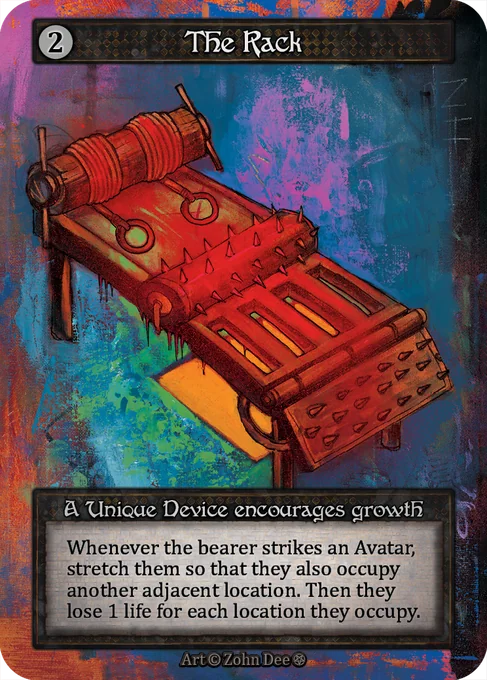
It may include some of your opponent's sites, but couldn't include the void (without Voidwalk) nor Gnome Hollows (unless its power was low enough). Determining Size and Occupying Locations A card's size is determined as it enters the realm (or via other effects, e.g. Megamoeba or The Rack) and becomes one of its characteristics.
Therefore, even if a Mountain Giant were disabled or in a Silence aura, it would continue to occupy a 2x2 area. Oversized units occupy each of their locations.
Therefore, if grid damage is dealt to multiple such locations, oversized units take damage at each of those locations.
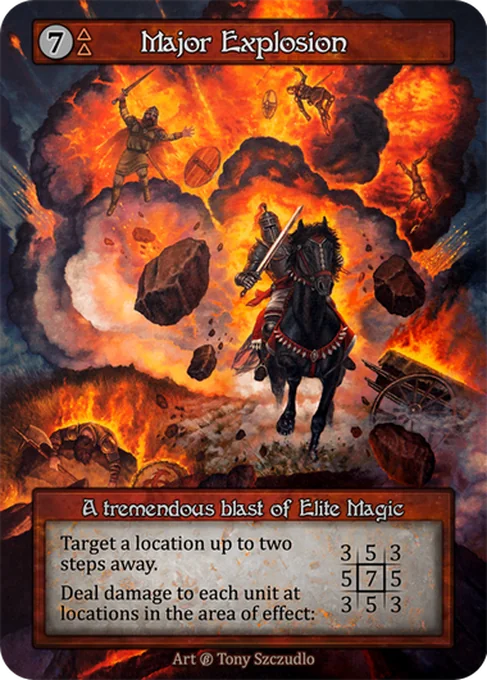
For example, a Major Explosion centered on a Mountain Giant would deal 7 + 5 + 5 + 3 = 20 damage to it. An oversized unit could simultaneously occupy both land and water sites, as well as void squares if it had voidwalk. It cannot occupy the surface and subsurface simultaneously, unless it has specific text allowing it, e.g. Megamoeba.
Moving When an oversized unit moves, you choose a direction and all parts of it move that direction. If any part of it cannot move in the chosen direction, then it cannot move in that direction at all. All parts of this movement are considered its movement path.
For example: If you cast Whirling Blades on an animated Drought aura, it can move two steps and then will strike enemies at any of the 8 locations it occupied, since all 8 locations are part of its movement path. (If it moved forward and back, then only 6 locations would be part of its movement path.) When moving, an oversized unit only 'enters' locations it did not occupy before taking each step. Attacking When attacking, oversized units must target a single enemy unit or site surface that shares a location with it.
For example, a Mountain Giant occupying sites in the squares marked with 'M' is attacking. It must choose an enemy unit or site surface in one of those locations. The attack is then happening at that location, and defenders must reach that specific location to defend.
Nearby and Adjacent When determining if a card is near or adjacent to an oversized unit, you check to see if it is near or adjacent to any location the oversized unit occupies.
For instance, the following locations marked 'a' are adjacent to the Mountain Giant, marked 'M': As a further example, the locations marked 'n' are nearby an oversized avatar, marked 'A,' that has been stretched into an L-shape by The Rack: In the above diagrams, the locations occupied by the oversized unit are also nearby/adjacent to the unit. For more detailed and specific rulings, see the subcodex entries below:
Since an oversized unit occupies more than one location, it cannot burrow or submerge itself when it occupies both a land site and a water site unless it has both the Submerge and Burrowing ability. When an effect attempts to burrow or submerge an oversized unit by force (e.g. Bury, Drown) the effect will fail unless the oversized unit occupies only one type of site (i.e. either all water sites, or all land sites).
For example, you cast Bury on a Mountain Giant that occupies the surface of three land sites and one water site. The effect will fail, since not all parts of the Giant can be burrowed.
When casting an artifact into the hands of an oversized unit, choose one of its locations to conjure the artifact to. It will be held by the oversized unit at that location. When an oversized unit carrying an artifact moves, the artifact stays in the same relative position within the oversized unit.
For instance, if you have a Mountain Giant at the locations marked 'M' and it is carrying an artifact in the location marked 'A', it will stay in that relative location while the Giant moves: Stepping to the right: Then stepping forward: The same rules will apply if an oversized unit is carrying another unit.
When an oversized unit moves, it does not 'traverse' borders that it was straddling before moving.
For example: if there is a Mountain Giant occupying the 'M' locations and a Perilous Bridge in square 'P', the Mountain Giant can step forward to square 1, because it will not be traversing the border between 2 and P. It could not step back down to P afterward, though, as then it would be crossing that border.
When an oversized unit is teleported, it must be to a location or set of locations that are all legal for that unit to occupy, and must not cross regional boundaries unless allowed by card text. If the teleport effect requires the oversized unit to be targeted, you must choose one of its locations where it can be legally targeted to be the part of the unit teleported. If the effect does not target, the controller of the effect may choose any part of the oversized unit to be the part which is teleported.
If the destination of the teleportation is a single location, the controller of the teleportation effect chooses the position and orientation of the unit, as long as the destination is included in the locations it ends up occupying.
For example, Mountain Giant is chosen as the ally for Blink: As the 'nearby location,' I choose X. Now, the Mountain Giant can end up in any of these positions: Since the Mountain Giant is a square shape, its orientation doesn't typically matter, but if it were carrying something, it could also be rotated as desired from the teleportation. For a more complicated example, an Avatar has been stretched by The Rack so that it is an asymmetrical shape, and is then chosen as the ally for Blink.
The controller decides that the part of the Avatar marked with 'x' will be teleporting to the square marked 'X': The Avatar can end up in any of the following orientations, given those choices: However, if a different section of the Avatar is chosen the be the part which teleports to a nearby location, a whole new set of orientations become available.
There are many cards that assume units occupy only one location or site. These cards will have language which refers to 'its site' or 'its location,' or words to that effect, in the context of a unit. When resolving such effects for oversized units, simply pick a single site or location they occupy.
For example, Spin Attack, Leap Attack, and Recall all assume the unit occupies only one location; to resolve them properly, you pick one location the oversized unit occupies.
When shooting a projectile, an oversized unit chooses one of its locations and the projectile shoots from there.
For example: If you case Grapple Shot and choose your Mountain Giant, occupying the squares marked with 'M/m,' for its effect. You must select one location occupied by the Giant to be the origin for the projectile, so you choose the location marked 'm.' The projectile shoots north and hits the Bosk Troll at 'B' and then drags the Giant to its location. The Giant will be dragged over the Vile Imp at 'V' and will occupy the four squares at the top of the diagram instead of the four at the bottom.